

Most SaaS founders make the same fatal mistake. They look at their analytics dashboard, see the traffic line going up, and assume the business is growing.
They are wrong.
Traffic is a vanity metric. You can have 100,000 monthly visitors and still struggle to make payroll if those visitors aren’t signing up.
For a software company, standard SEO advice fails. You don’t need random readers; you need Monthly Recurring Revenue (MRR). You need users who stay, upgrade, and advocate for your product.
This guide ignores the generic advice. We focus strictly on Revenue-Led SEO—strategies designed to lower your Customer Acquisition Cost (CAC) and scale your ARR efficiently.
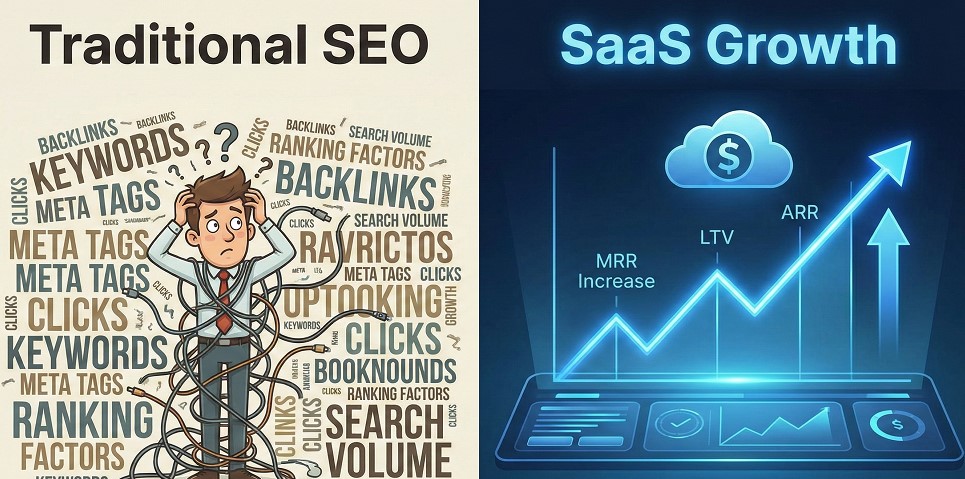
What is SaaS SEO? (And Why It’s Different)
SaaS SEO (Software as a Service Search Engine Optimization) is the process of positioning your software in front of decision-makers who are actively looking for a solution.
Unlike affiliate or e-commerce SEO, the goal isn’t a one-time purchase. The goal is to drive Free Trial Signups, Demos, and ultimately, long-term retention (LTV).
The “Product-Led” Shift
In traditional content marketing, you cast a wide net. In SaaS, you must be surgical. You are targeting the “Problem Aware” and “Solution Aware” stages of the funnel.
Here is how the mindset shifts:
| Feature | Traditional SEO | SaaS SEO |
| Primary Goal | Pageviews & Ad Impressions | Signups (MQLs) & MRR |
| Keyword Focus | High Volume, Broad Appeal | High Intent, Niche Specific |
| Conversion | Email Newsletter Signup | Free Trial / Book a Demo |
| Success Metric | Time on Page | Customer Acquisition Cost (CAC) |
The Strategy: Targeting “High-Intent” Keywords
Stop writing generic “What is X?” articles. Your competitors with bigger budgets already dominate those.
Instead, capture demand that already exists. Focus on Bottom of Funnel (BoFu) intent. These users have their credit cards out; they just need to know which tool to buy.
1. The “Alternative” Keyword
Your biggest competitors have spent millions building brand awareness. Piggyback on it.
- Target: “[Competitor] Alternative”
- Example: If you built a CRM, target “Salesforce Alternative for Small Business.”
- Why it works: The user already knows they need a CRM, but they are unhappy with the market leader. They are hot leads.
2. The “Vs” Comparison
Buyers love to compare options before committing.
- Target: “[Your Brand] vs. [Competitor]” or “[Competitor A] vs. [Competitor B]”
- Why it works: You control the narrative. Create a comparison page that honestly highlights where you win (e.g., pricing, ease of use).
3. The “Best For” Use Case
Software is not one-size-fits-all. Niche down.
- Target: “Best [Software Category] for [Industry/Role]”
- Example: “Best Project Management Tool for Creative Agencies.”
Technical SEO for Software: Building a Scalable Foundation
SaaS websites are often complex web applications, not simple blogs. This creates unique technical hazards that can kill your rankings.
Mastering JavaScript Rendering
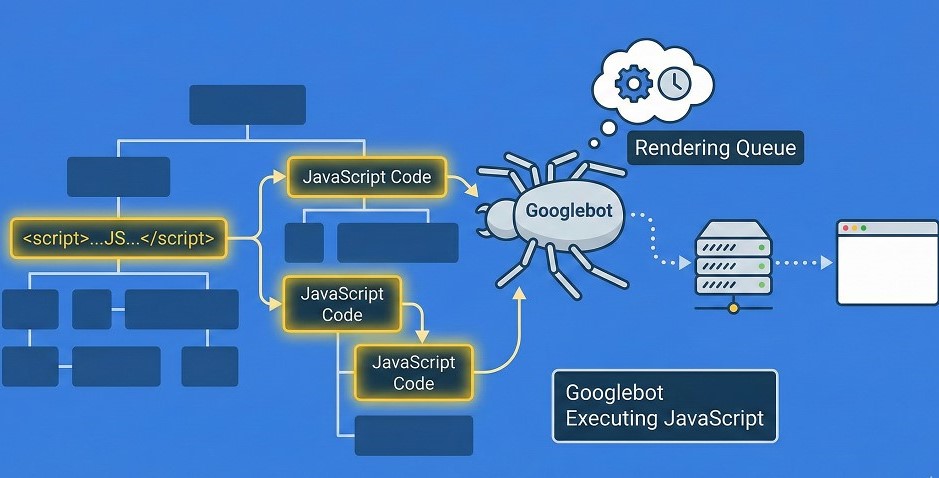
Many SaaS marketing sites are built on frameworks like React or Angular. Google is getting better at reading JavaScript, but it isn’t perfect.
- The Risk: Googlebot might see a blank page if your content relies entirely on client-side rendering.
- The Fix: Use Server-Side Rendering (SSR) or rigorous pre-rendering to ensure Google sees your text immediately.
Managing “Zombie” Pages
Software companies often spin up thousands of programmatic pages (e.g., integration pages, feature sub-pages).
- The Risk: “Crawl Budget Waste.” Google spends time crawling low-value empty pages instead of your core money pages.
- The Fix: Audit your site architecture regularly. Prune low-quality pages or consolidate them.
Content Architecture: The Topic Cluster Model
You cannot become an authority by posting random articles. You need structure.
Google’s algorithms (and modern LLMs) look for Topical Authority. They want to see that you cover a subject depth-first.
Build this structure:
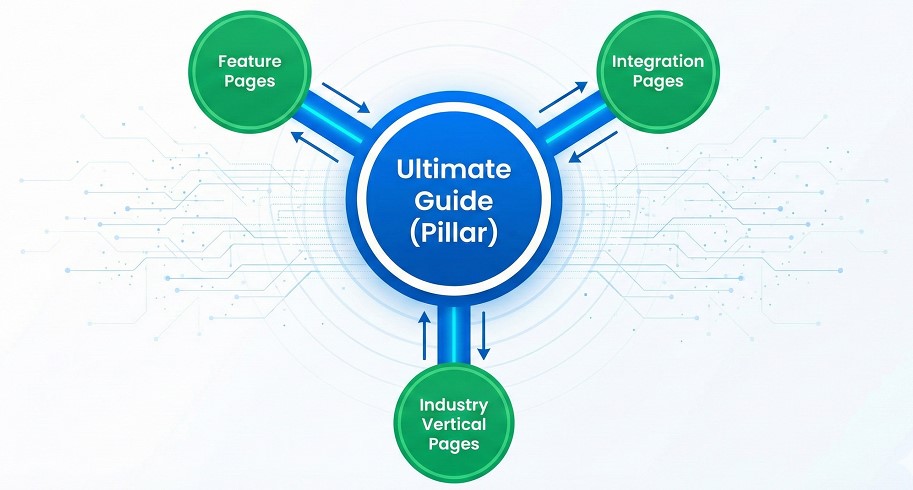
- The Pillar Page: A massive, high-level guide (like this one) covering the broad topic.
- Cluster Content: 5-10 supporting articles that dive deep into specific sub-topics (e.g., “SaaS Link Building,” “Keyword Research for B2B”).
- Internal Linking: Link every cluster post back to the Pillar, and link the Pillar to every cluster post. This signals to Google that these pages are related.
Essential SaaS SEO Tools (And How to Save on Them)
Executing this strategy requires data. You cannot guess keyword volume or competitor backlinks.
At a minimum, you need a stack that covers:
- Keyword Research: (Ahrefs, SEMrush)
- Technical Audits: (Screaming Frog, Sitebulb)
- Rank Tracking: (SERPWatcher, AccuRanker)
A Note on Budget:
Enterprise SEO tools are expensive. For a bootstrapped startup, paying $200-$500/month for software can burn your runway fast.
Smart founders don’t pay full price if they don’t have to. Check platforms like OfferLooters to find lifetime deals (LTDs) on software alternatives. We curate tech deals that allow you to secure powerful SEO and marketing tools for a fraction of the cost, often with a one-time payment. This keeps your CAC low and your margins high.
Measuring ROI: Tracking Signups, Not Just Clicks
If you cannot prove ROI, your SEO strategy will get cut.
Stop reporting on “Impressions.” Your stakeholders don’t care. Shift your reporting to Revenue Attribution.
The Metrics That Matter:
- Organic Trial Signups: How many people hit “Start Free Trial” after clicking a Google result?
- MQL to SQL Conversion: Do organic leads actually talk to sales?
- Churn Rate: Do SEO-acquired users stay longer than users from Facebook Ads? (Usually, yes).
Set up “Goals” in Google Analytics 4 (GA4) specifically for the thank-you page users see after confirming their email. That is your true north star.
Conclusion: Your 90-Day Growth Plan
SaaS SEO is a compound interest game. The work you do today pays dividends in six months.
Start here:
- Week 1: Audit your technical foundation. Ensure Google can read your site.
- Week 2: Identify your “Bottom of Funnel” keywords (Alternatives & Comparisons).
- Month 2: Build your first “Topic Cluster” around your core product feature.
- Ongoing: Monitor MRR attribution.
Don’t wait for viral success. Build a predictable, revenue-generating machine.
Frequently Asked Questions (FAQ)
What is SaaS SEO?
SaaS SEO is the strategy of driving organic traffic to software websites with the specific intent of generating product signups and revenue. Unlike traditional SEO, it prioritizes “bottom-of-funnel” keywords that target decision-makers ready to buy, rather than general information seekers.
How is SaaS SEO different from traditional SEO?
SaaS SEO focuses on MRR (Monthly Recurring Revenue) and Retention, whereas traditional SEO focuses on traffic volume.
Key differences include:
- KPIs: Signups vs. Pageviews.
- Content: Comparison/Feature pages vs. General blogs.
- Technical: Handling complex JavaScript web apps vs. static HTML sites.
What are the best keywords for SaaS companies?
The best keywords are high-intent terms that indicate a user is looking for a solution.
Focus on:
- “Alternatives”: (e.g., “Asana alternative”)
- “Vs”: (e.g., “Zoom vs. Teams”)
- “Best for”: (e.g., “Best accounting software for freelancers”)
- “Integrations”: (e.g., “Slack Google Sheets integration”)
How do I measure SaaS SEO success?
Measure success by tracking Organic Trial Signups, Qualified Leads (SQLs), and Customer Acquisition Cost (CAC).
Avoid vanity metrics like “Total Impressions.” If traffic goes up but signups stay flat, your strategy is failing. Use attribution tools to track which blog posts generate the most paying customers.
What is Programmatic SEO for SaaS?
Programmatic SEO is the automated creation of landing pages to target thousands of long-tail keyword variations.
Common SaaS examples include generating unique landing pages for every possible integration (e.g., “Connect X with Y”) or “Competitor Comparison” pages. This allows you to scale content production without writing every page manually.