
You are likely spending too much money to acquire customers.
In the early days of a SaaS startup, paid ads and cold outreach feel necessary. But they create a dependency. The moment you stop feeding the machine with cash, the leads stop flowing. This is the “rent-seeking” trap of traditional marketing.
There is a better way. Instead of renting attention, you need to build an asset that generates its own momentum.
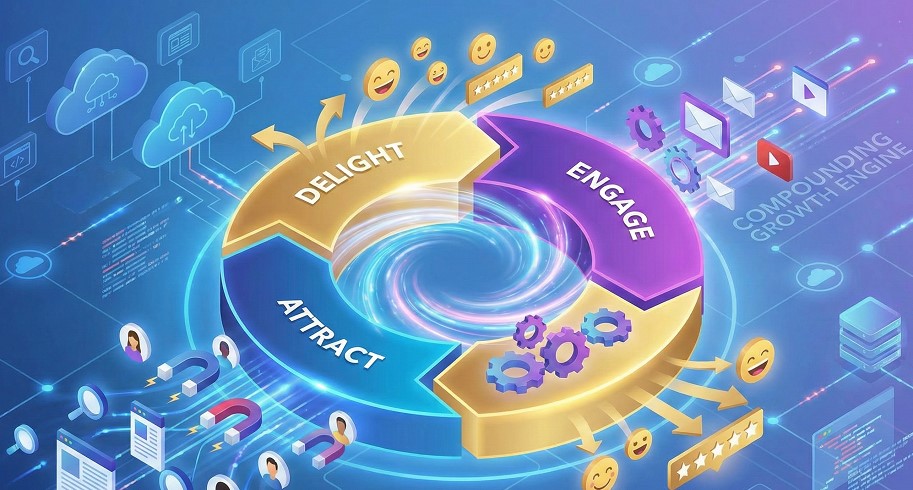
That asset is a SaaS Content Marketing Flywheel. Unlike a linear funnel that dumps customers out at the bottom, a flywheel uses your existing success to drive future growth. It lowers your Customer Acquisition Cost (CAC) and creates a compounding loop of traffic and revenue.
Here is how to build one.
The Death of the Funnel: Why SaaS Needs Circular Growth
The traditional marketing funnel is broken for modern SaaS.
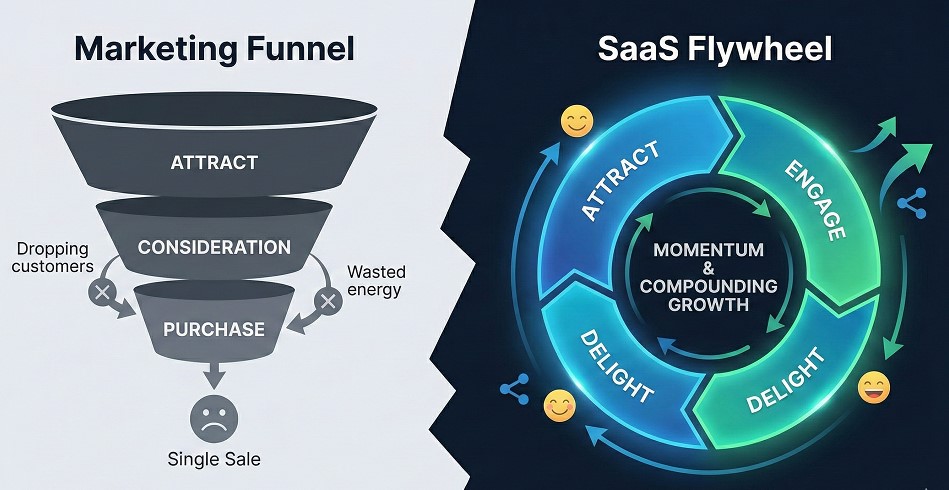
In a funnel, you pour traffic into the top (Awareness), filter it down through Consideration, and squeeze out a sale at the bottom. Once the transaction happens, the process ends. You have to go back to the top and pay to acquire the next customer.
This is a massive waste of energy.
The Flywheel model changes the physics of your growth. In this model, the “customer” isn’t the output; they are the input for the next cycle. Happy customers provide reviews, referrals, and user-generated content (UGC), which feeds the “Attract” phase for new users.
Key difference: A funnel consumes energy to create customers. A flywheel stores energy to create momentum.
The 3 Stages of a Self-Sustaining Flywheel
To get your flywheel spinning, you need to align your content strategy with three specific phases. This isn’t about just writing blog posts; it’s about engineering a system.
1. Attract (The Magnet)
This is where you earn attention without forcing it. Instead of interrupting users with ads, you answer their questions.
- Tactics: SEO-driven blog posts, YouTube tutorials, and free tools (like calculators or templates).
- Goal: Solve a small problem for free so they trust you with the big problem later.
2. Engage (The Relationship)
Once they are on your site, you need to make it easy for them to engage with your product.
- Tactics: Email courses, interactive demos, and knowledge bases.
- Goal: Remove friction. The transition from “visitor” to “user” should be seamless.
3. Delight (The Accelerator)
This is the most critical and neglected phase. You must create an experience so good that users become promoters.
- Tactics: Customer success stories, community spotlights, and referral programs.
- Goal: Turn your user base into your marketing team.
Building Your Flywheel Tech Stack (Without Breaking the Bank)
A functional flywheel requires heavy tooling. You cannot manage this manually. You need a stack that handles automation, analytics, and content distribution.
At a minimum, you need:
- SEO Tools (Semrush, Ahrefs) to find topics.
- Automation Platforms (Zapier, Make) to connect your leads to your CRM.
- Social Schedulers (Buffer, Hootsuite) for distribution.
- Visual Design Tools (Canva) for assets.
The Problem: These subscriptions add up fast. A standard marketing stack can easily cost $500–$1,000 per month. For a bootstrapped SaaS, that burns through your runway.
The Solution: Smart founders don’t pay full retail price for software. They look for Lifetime Deals (LTDs).
Platforms like OfferLooters are essential resources for this stage. OfferLooters aggregates software deals that allow you to pay once for tools that you would normally rent monthly. By securing your tech stack through lifetime deals found on OfferLooters, you drastically lower your overhead. This keeps your CAC low and ensures your flywheel remains profitable, even in the early stages.
Friction vs. Force: How to Speed Up the Loop
Physics dictates how fast your flywheel spins. Two variables control the speed: Force (what you add) and Friction (what holds you back).
To grow, you must maximize force and eliminate friction.
| Feature | Force (Do More of This) | Friction (Eliminate This) |
| Content | High-value, original research, free tools. | Fluff pieces, generic AI content, paywalls on basic info. |
| UX/UI | Self-serve signups, clear pricing, instant demos. | “Book a demo” forms, hidden pricing, slow load times. |
| Community | Active user groups, incentivized referrals. | Ignored support tickets, no onboarding process. |
| Distribution | Native social content, employee advocacy. | Link dumping, spamming DMs. |
The Content Repurposing Waterfall (Your Fuel Source)
The biggest objection to the flywheel model is: “I don’t have time to create that much content.”
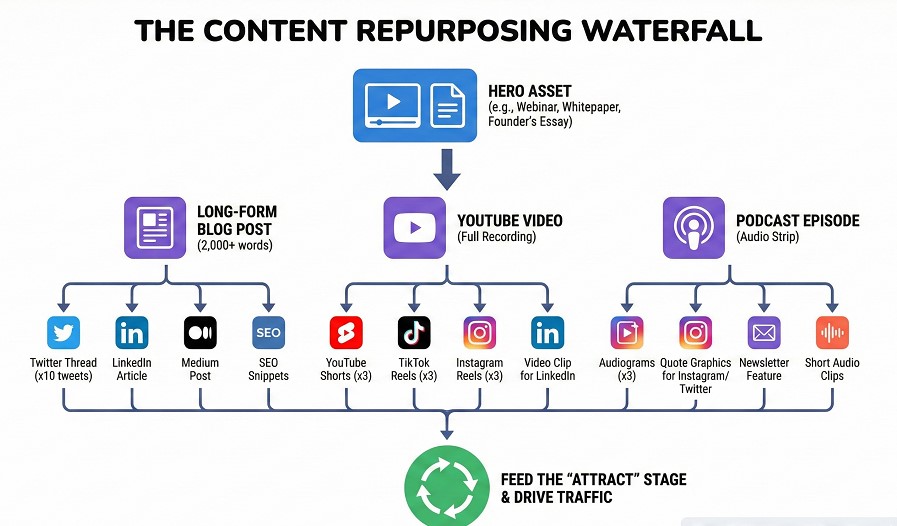
You don’t need to create more; you need to repurpose better. Use the Waterfall Method.
- Create one “Hero Asset”: This is a heavy-lift item like a Webinar, a Whitepaper, or a long-form Founder’s Essay.
- Split it: Turn that one asset into a 2,000-word blog post.
- Atomize it: Break the blog post into a Twitter thread, a LinkedIn carousel, and three YouTube Shorts.
- Distribute it: Post these assets over 4 weeks.
This ensures you are constantly feeding the “Attract” stage of your flywheel without burning out your creative energy.
Measuring Momentum: KPIs That Matter
Vanity metrics (likes and pageviews) don’t measure momentum. To track the health of your flywheel, focus on these three KPIs:
- Viral Coefficient: How many new users does each existing user bring in? If this number is above 1.0, you have achieved exponential growth.
- Churn Rate: A leaky bucket kills the flywheel. You cannot build momentum if you are losing customers faster than you gain them.
- Time to Value (TTV): How fast does a user get a “win” from your content or product? The faster the TTV, the faster they move to the “Delight” phase.
Frequently Asked Questions (FAQ)
What is a SaaS content marketing flywheel?
A SaaS content marketing flywheel is a circular growth strategy. Instead of a linear funnel that ends at the sale, the flywheel uses happy customers to drive referrals and advocacy, creating a self-sustaining loop of acquisition.
How is a flywheel different from a marketing funnel?
The main difference is energy retention. A funnel is linear and loses energy at the bottom (customer purchase). A flywheel is circular and captures the energy of current customers to attract new ones, compounding results over time.
What tools do I need to build a content flywheel?
You need a stack for creation, distribution, and analytics. Essentials include a CMS (WordPress), SEO tools, and automation platforms. Check OfferLooters to find lifetime deals on these tools to keep your monthly costs low.
Why is the flywheel model better for B2B SaaS?
It lowers Customer Acquisition Cost (CAC). B2B SaaS relies on trust and retention. The flywheel leverages your most effective marketing asset—your current user base—to bring in high-quality leads that are cheaper to acquire and easier to close.